About Horizon Europe
  • About Horizon Europe
  • Structure
  • Horizontal Actions
  • EU Missions
  • Budget
  • NCP
  • Associated Countries
  • Strategic Plan
  • HE Guide & Manual
  • Guide
Basic Information
Horizon Europe
The EU Research & Innovation Programme
2021-2027

Horizon Europe is the EU’s key funding programme for research and innovation, with a budget of EUR 93.5 billion. As a multilateral international research programme, it facilitates international collaboration to address global challenges, tackle climate change, advance the UN’s Sustainable Development Goals, and boost industrial competitiveness.

The programme strengthens the impact of research and innovation by supporting the creation and diffusion of excellent knowledge and technologies, and by contributing to the implementation of EU and global policies. It engages the global talent pool to drive economic growth and maximise the impact of investments within a strengthened European Research Area.

As the Republic of Korea became an associated country starting in 2025, Korean organization can fully participate in Pillar II projects and receive EU funding directly.

Structure
Budget overview 1
Horizon Europe Structure

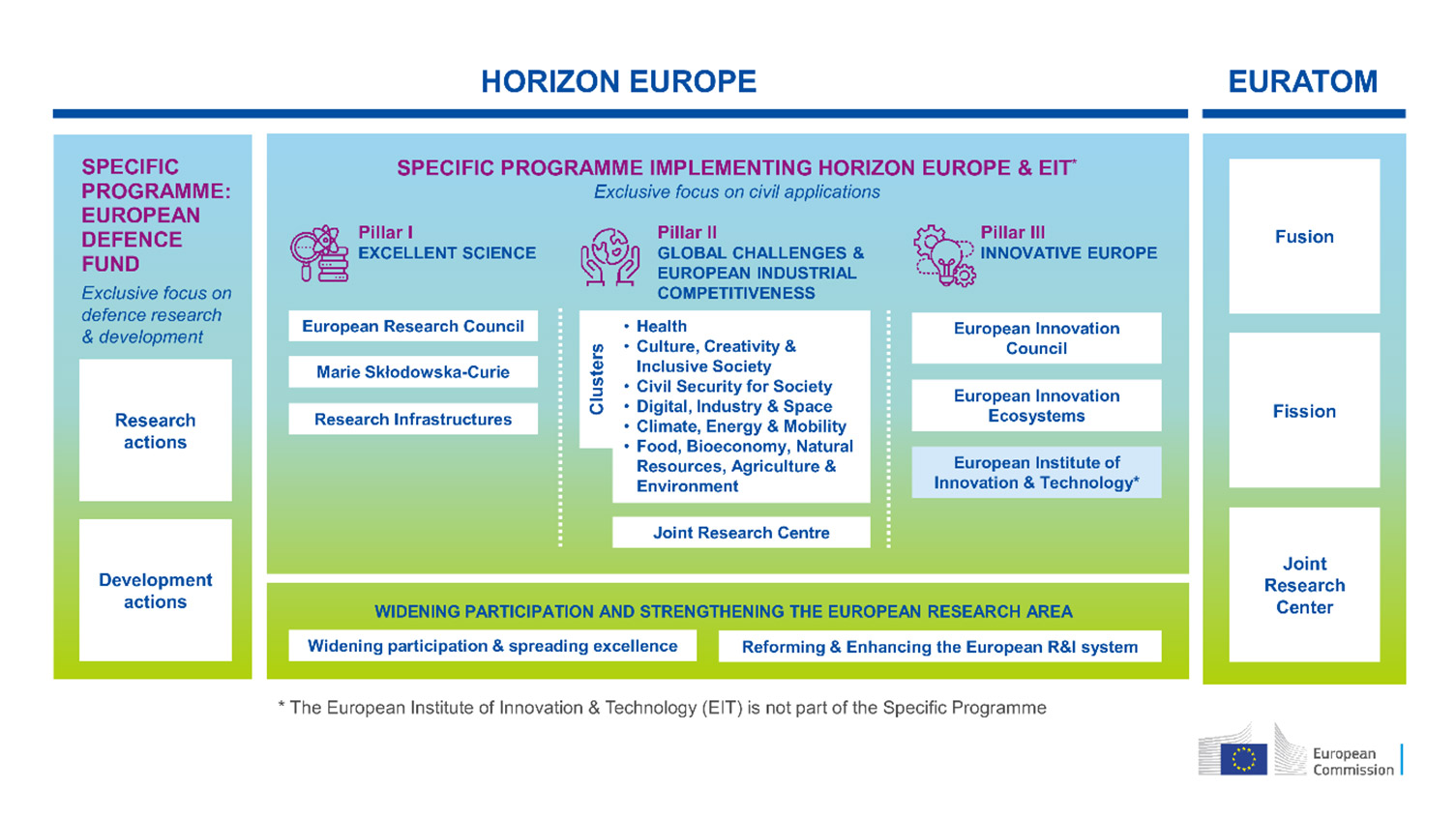
Horizon Europe consists of three main pillars.

Pillar I: Excellent Science Aims to bring and keep science in Europe at the highest level by attracting the world’s best researchers and providing access to premier research infrastructures.

Key Components: European Research Council (ERC) for frontier research, Marie Skłodowska-Curie Actions (MSCA) for researcher mobility, and support for world-class Research Infrastructures.

Pillar II: Global Challenges and European Industrial Competitiveness Focuses on major global challenges aligned with the UN’s Sustainable Development Goals (SDGs) through international joint research and innovation.

Key Components: Organized into six clusters (Health; Culture, Creativity & Inclusive Society; Civil Security for Society; Digital, Industry & Space; Climate, Energy & Mobility; Food, Bioeconomy, Natural Resources, Agriculture & Environment).

Participation: As an associated country, the Republic of Korea is eligible to participate in these clusters and receive EU funding directly.

Pillar III: Innovative Europe Focuses on stimulating market-creating breakthroughs and ecosystems conducive to innovation to strengthen EU competitiveness.

Key Components: Primarily supports high-potential innovators through the European Innovation Council (EIC) and the European Institute of Innovation and Technology (EIT).
In addition to the three pillars, Horizon Europe includes horizontal actions designed to strengthen the European Research Area (ERA), as well as complementary programmes:

Horizontal Actions: Widening Participation and Strengthening the ERA Uses various instruments to reform and enhance the ERA, ensuring excellence is spread across all member states.

Instruments: Includes Teaming, Twinning, and COST (European Cooperation in Science and Technology) to build R&I capacity.

Specific and Complementary Programmes

European Defence Fund: Focuses exclusively on collaborative defence research and development.

Euratom Research and Training Programme: Concentrates on nuclear fusion and fission research, safety, and training.

Pillar 1 : Excellent Science
1
European Research Council (ERC)
The ERC funds frontier research driven by the best researchers across all career stages.

Grant Types:Starting, Consolidator, Advanced, Synergy, Proof of Concept, and Plus (New from 2026).

Further information:Please refer to the Pillar I (ERC) guidebook for Korea: https://k-erc.eu/wp-content/uploads/2025/09/Horizon-Europe-Pillar-1-Application-Guidebook-ERC-MSCA-PF-book.pdf

2
Marie Sklodowska-Curie Actions (MSCA)
MSCA is the EU’s flagship programme for doctoral education and postdoctoral training. It supports the mobility of researchers across borders, sectors, and disciplines to enhance their skills and career development.

Key Programs: It funds Doctoral Networks for PhD candidates, Postdoctoral Fellowships for experienced researchers, and Staff Exchanges to promote international and inter-sectoral collaboration.

3
Research Infrastructure (RI)
RI provides funding to establish and optimize world-class research facilities and resources that are essential for scientific excellence.

Support Method: It supports research communities by providing transnational access to state-of-the-art facilities and funding the development of integrated digital services and data infrastructures to foster innovation in various fields.

Pillar 2 : Global Challenges and European Industrial Competitiveness
Pillar II focuses on tackling major global challenges and strengthening European industrial competitiveness through large-scale international collaborative research. It is designed to provide scientific and technological solutions that directly support EU policy priorities and the UN’s Sustainable Development Goals (SDGs).
This pillar encourages cross-border and cross-sectoral cooperation, bringing together researchers, industries, and stakeholders from around the world.
As an associated country, the Republic of Korea is fully eligible to participate in Pillar II projects, allowing Korean researchers and institutions to join consortia and receive research funding from the EU directly.
Clusters
1
Health
  1. Health throughout the life course
  2. Non-communicable and rare diseases
  3. Tools, technologies and digital solutions for health and care, including personalised medicine
  4. Environmental and social health determinants
  5. Infectious diseases, including poverty-related and neglected disease
  6. Health care systems
2
Culture, Creativity & Society
  1. Democracy and Governance
  2. Social and economic transformations
  3. Culture, cultural heritage and creativity
3
Civil Security for Society
  1. Disater-resilient societies
  2. Protection and Security
  3. Cybersecurity
4
Digital, Industry and Space
  1. Manufacturing technologies; Advanced materials; Next generation internet
  2. Circular industries; Space, including Earth Observation; Emerging enabling technologies
  3. Key digital technologies, including quantum technologies
  4. Artificial Intelligence and robotics; Advanced computing and Big Data
  5. Low-carbon and clean industry; Emerging enabling technologies
5
Climate, Energy and Mobility
  1. Climate science and solutions; Energy systems and grids; Communities and cities
  2. Industrial competitiveness in transport; Smart mobility; Energy supply
  3. Buildings and industrial facilities in energy transition
  4. Clean, safe and accessible transport and mobility; Energy storage
6
Food, Bioeconomy, Natural Resources, Agriculture and Environment
  1. Environmental observation; Agriculture, forestry and rural areas
  2. Circular systems; Food systems
  3. Biodiversity and natural resources; Seas, oceans and inland waters
  4. Bio-based innovation systems in the EU; Bioeconomy
7
Joint Research Centre
The JRC serves as the European Commission's science and knowledge service, providing independent scientific evidence and support throughout the whole policy cycle. It plays a crucial role in addressing complex societal challenges by providing non-nuclear direct actions that underpin EU policy-making.
Pillar 3 : Innovative Europe
1
European Innovation Council (EIC)
Focus on market-creating innovation and SME growth.
  • EIC Pathfinder supports the exploration of bold ideas for radically new technologies. It welcomes the high-risk / high gain and interdisciplinary cutting-edge science collaborations that underpin technological breakthroughs.
  • EIC Accelerator supports individual SMEs, in particular Startups and spinout companies to develop and scaleup game-changing innovations.
  • EIC Transition funds innovation activities that go beyond the experimental proof of principle in laboratory to support the maturation and validation of the novel technology in the lab and in relevant application environments, and the development of a business case and model towards the innovation’s future commercialisation.
2
European Innovation Ecosystems (EIE)
Connects with regional and national actors to improve the overall innovation ecosystem across Europe. Ecosystems should become more connected and efficient.
3
European Institute of Innovation and Technology (EIT)
Focuses on integrating research, higher education, business and entrepreneurship. The EIT is an independent EU body that supports entrepreneurial talent and innovative ideas through specific calls for proposals.
HE Guide & Manual
General Annexes (Horizon Europe Work Programme 2026-2027)
These General Annexes set out the general conditions applicable to calls and topics for grants and other forms of funding under the Horizon Europe main work programme. They also describe the evaluation and award procedures and other criteria for Horizon Europe funding.

In particular, the General Annexes outline the

  • admissibility and eligibility conditions, and the criteria for financial and operational capacity and exclusion (Annexes A-C)
  • award criteria, mandatory documents and evaluation procedure (Annexes D-F)
  • legal and financial set-up of the grant agreements (Annex G)
  • specific conditions applying to actions which include pre-commercial procurement or procurement of innovative solutions (Annex H)
Horizon Europe Programme Guide
It outlines the detailed guidance on the structure, budget and political priorities of Horizon Europe.
EU Funding & Tenders Online Manual for EU funding Programmes 2021-2027
The online manual outlines the procedures to register and submit applications online via the EU Funding & Tenders Portal and recommendations on preparing the application.
THE AGA – Annotated Grant Agreement
The AGA contains detailed annotations on all the provisions in the grant agreement that must be signed to obtain the grant.
Consortium Agreement Guide
This document aims to assist applicants/beneficiaries in drawing up a consortium agreement. Following model consortium agreements are the most widespread model Consortium Agreement in Horizon projects.
EU Funding & Tenders Portal
Horizon Europe 2028-2034
Horizon Europe (2028-2034) Overview
Horizon Europe (2028-2034) is the European Union’s proposed research and innovation framework aimed at boosting productivity, competitiveness, and citizen well-being. It builds upon previous successes while simplifying access and focusing investments on Europe’s most critical needs.
1
Budget and Four-Pillar Structure
The Commission proposes a total budget of €175 billion, organized into four distinct pillars:

Pillar I: Excellent Science (€44.079B): Supports frontier research through the European Research Council (ERC), Marie Skłodowska-Curie Actions, and science-based policy support.

Pillar II: Competitiveness and Society (€75.876B): Focuses on industrial decarbonization, health, biotech, digital leadership, and security. It also manages global challenges, EU Missions, and the New European Bauhaus.

Pillar III: Innovation (€38.785B): Dedicated to the European Innovation Council (EIC) and innovation ecosystems to bridge the gap between knowledge and market.

Pillar IV: European Research Area (€16.262B): Strengthens ERA policies, funds cutting-edge research infrastructures, and focuses on widening participation to spread excellence across the continent.

2
Key Improvements and Delivery

Simple and Fast Access: Shorter work programmes, unified funding rates, and expanded lump-sum options to reduce red tape.

Innovation Boost: Expanded EIC to support deep-tech startups in quantum, biotech, and clean-tech, including dual-use and defense technologies.

Strategic Partnerships: Streamlined collaborations with Member States and the private sector aligned with strategic industrial sectors.

3
Strategic Moonshots
The programme introduces "Moonshots"—ambitious, technology-driven projects designed to secure Europe's strategic autonomy:

Energy & Environment: Aiming for the first commercial fusion power plant by 2034, clean CO2-free aviation, and zero water pollution.

Digital Leadership: Integrating quantum computing into daily life and developing next-generation AI grounded in physics and biology.

Science & Economy: Investing in the Future Circular Collider for particle physics and establishing a dominant space economy with reusable rockets.

Health: Delivering breakthrough regenerative therapies to treat previously incurable diseases.Streamlined collaborations with Member States and the private sector aligned with strategic industrial sectors.

Work Programme
Horizon Europe work programmes
Horizon Europe supports research and innovation especially through work programmes , which set out funding opportunities for research and innovation activities.
1
The main work programme
  • Marie Skłodowska Curie actions and research infrastructures (Pillar I)
  • all clusters (Pillar II)
  • European innovation ecosystems (Pillar III)
  • Widening Participation and Strengthening the European Research Area part (Horizontal Actions)
2
Other work programmes
  • European Research Council (ERC)
  • Joint Research Centre (JRC)
  • European Innovation Council (EIC)
Other Work Programmes and Documents
The work programmes for Horizon Europe are available to view and download on the Funding and Tenders Portal.
Key Strategic Orientations for Research & Innovation
Horizon Europe Strategic Planning (2021-2024, 2025-2027)
The Horizon Europe Strategic Plan serves as the roadmap for EU research and innovation funding, ensuring that investments align with the Union’s political priorities. By integrating the orientations of the first (2021-2024) and second (2025-2027) planning periods, Horizon Europe addresses global challenges through a consistent and ambitious framework.
Key Strategic Orientations
Horizon Europe focuses on core pillars that drive Europe’s future, evolving from the initial four orientations into a streamlined approach for the 2025-2027 period:

The Green Transition: Focused on making Europe the first climate-neutral and circular economy. This includes restoring ecosystems and biodiversity, managing natural resources sustainably, and transforming energy, mobility, and production systems. The programme commits to a 35% climate expenditure target and a dedicated 10% budget for biodiversity-related topics for 2025-2027.

The Digital Transition: Leading the development of key digital and emerging technologies. This orientation promotes a competitive, secure data-economy and high-quality digital services, ensuring that the digital shift remains human-centred and secure.

A Resilient, Competitive, and Inclusive Europe: Strengthening the social fabric by addressing inequalities, providing high-quality healthcare, and protecting democratic society. This includes preparing for emerging threats and disasters while fostering inclusive growth and new job opportunities.

Overarching Principles: Open Strategic Autonomy
Across all periods, Open Strategic Autonomy remains a guiding principle. This ensures Europe’s leading role in developing and deploying critical technologies, sectors, and value chains, thereby securing a competitive edge in the global landscape while maintaining an open and democratic society.
Key Implementation Elements (2025-2027)
To maximize the impact of these strategic orientations, the plan for 2025-2027 introduces and reinforces several key initiatives:

Expected Impacts: 32 defined impacts distributed across the various clusters of Pillar II to tackle specific global challenges.

European Partnerships: Implementation of 9 new co-programmed and co-funded partnerships to align EU and national R&I agendas.

EU Missions: Continued commitment to high-visibility portfolios of actions designed to achieve bold, measurable goals for society.

New European Bauhaus Facility: Integrating the European Green Deal into our living spaces and experiences through innovation and design.

Associated Countries
Legal entities from associated countries can participate under equivalent conditions as legal entities from the EU Member States, unless specific limitations or conditions are laid down in the work programme and/or call/topic text. The following countries have association agreements that have started to produce legal effects:
  • Albania
  • Armenia
  • Bosnia and Herzegovina
  • Canada
    (Associated to Pillar II, including institutionalised European partnerships, for 2024 budget onwards)
  • Faroe Islands
  • Georgia
  • Iceland
  • Israel
  • Kosovo
  • Moldova
  • Montenegro
  • New Zealand
    (Associated to Pillar II as from Work Programmes 2023 onwards, including institutionalised European partnerships)
  • North Macedonia
  • Norway
  • Republic of Korea
    (Associated to Pillar II, including institutionalised European partnerships, for 2025 budget onwards)
  • Serbia
  • Switzerland
    (Associated to the entire Programme for 2025 budget onwards)
  • Tunisia
  • Türkiye
  • Ukraine
  • United Kingdom
    (Associated to the entire Programme, with the only exception of the EIC fund, for 2024 budget onwards)
Third Countries covered by Transitional Arrangements
Until association agreements start producing legal effects, transitional arrangements apply to the following countries where association negotiations are being processed or where association is imminent
  • Egypt
    (Applicable to the entire Programme for 2025 budget onwards)
  • Japan
    (Applicable to Pillar II, including institutionalised European partnerships, for 2026 budget onwards)
  • Morocco
    (Applicable for the entire Programme)
BUDGET
HORIZON EUROPE – The most ambitious EU Research & Innovation programme ever
An ambitious budget to find solutions to our main challenges
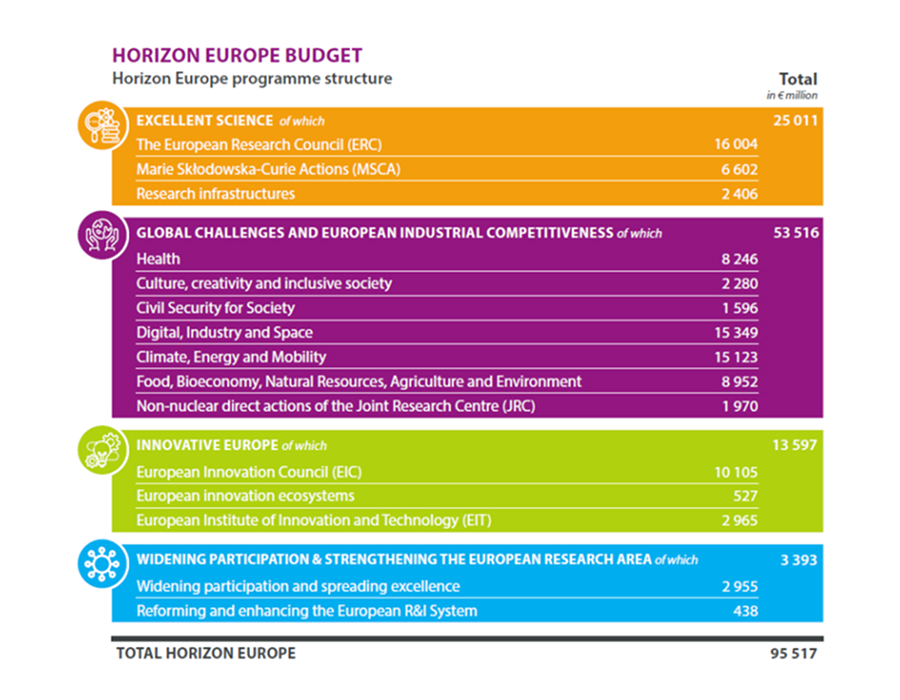
Horizon Europe has a budget of EUR 95.5 billion for the period from 2021-2027. This includes EUR 5.4 billion from the Next Generation EU instrument, particularly to support the green and digital recovery from the COVID crisis.
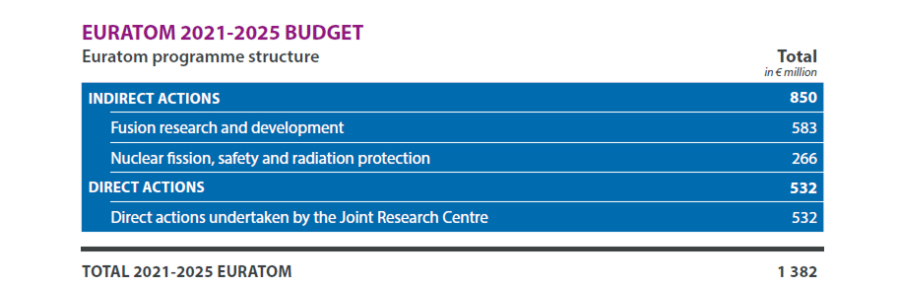
Horizon Europe is complemented by the Euratom 2021-2025 research and training programme. This programme has a budget of EUR 1.4 billion over the period 2021-2025, bringing the total budget available for both programmes to EUR 96.9 billion.
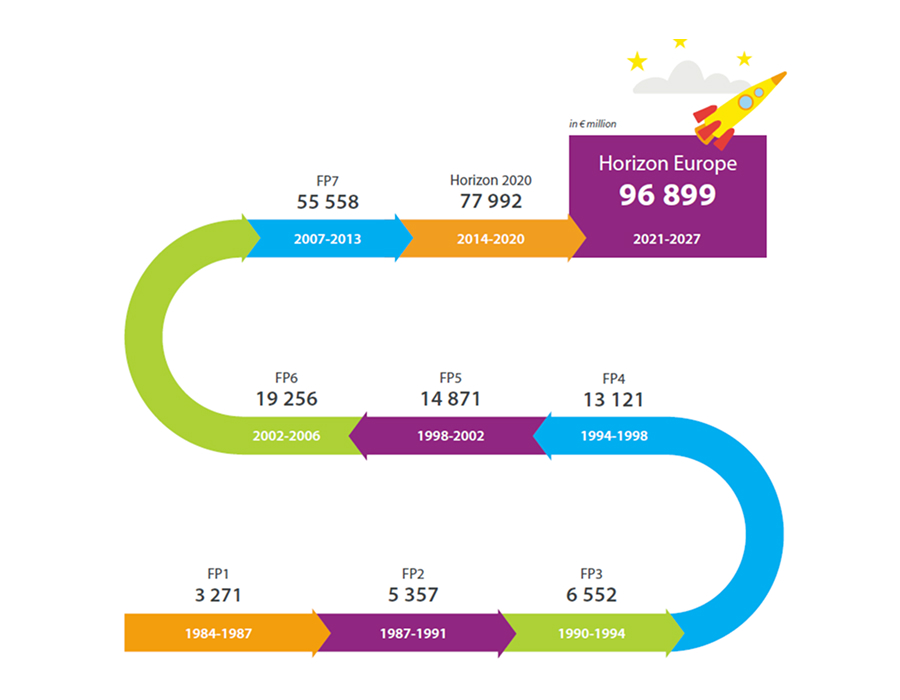
The EU budget has been significantly rising over time from EUR 3,271 million in FP1 to EUR 96,899 million today for Horizon Europe and Euratom. This illustrates the clear ambition of the EU for its main R&I funding instrument and increases relevance of science and technology in society to address our challenges.
How will the budget be invested?
The budget will be used to support R&I across the EU and Associated Countries, being paid directly to researchers, innovators and research institutions in the Members States and Associated Countries.

The Horizon Europe Regulation establishes a range of targets with respect to the use of the budget :
  • 35% of the budget will contribute to climate objectives
  • there will be a substantial increase of spending in main digital research and innovation activities compared to Horizon 2020.
  • 70% of the budget of the European Innovation Council will be allocated to small and medium size enterprises.
  • At least 3.3% of the budget will be committed to the programme part widening participation and spreading excellence.
  • Investments in Space should also be commensurate with those under Horizon 2020
  • the participation of industry in the actions should be supported at levels at least commensurate with those under Horizon 2020.
  • The budget should contribute to the overall ambition of providing 7.5% of annual spending under the MFF to biodiversity objectives in 2024 and 10% of annual spending under the MFF to biodiversity objectives in 2026 and 2027.
NCP
NCP: National Contact Points
National Contact Points (NCPs) are support structures established by Member States (MS) and Associated Countries (AC) and recognized by the European Commission (EC) to help participants access various EU programme opportunities. For Horizon Europe, there are 17 different NCP functions plus a national coordinators network, providing comprehensive support across all parts of the programme. Serving as the primary bridge, NCPs provide essential guidance to ensure smooth research and innovation (R&I) cooperation between Korea and the EU.
Primary Role of NCPs
  • Spreading Awareness : They ensure that potential applicants are well-informed about the latest Horizon Europe calls, guidelines, and manuals.
  • Specialist Advice: NCPs provide on-the-ground guidance and expert technical advice tailored to specific R&I fields.
  • Information Analysis: They collect and analyze information on European research trends and policies to promote effective collaboration.
  • Network Building: They strengthen cooperation networks between Korean and European R&I institutes to help researchers find partners for future projects.
NCPs provide highly professional services, including pre-proposal checks and administrative advice, to improve the quality and success rate of applications.
Korean NCPs
There is a dedicated pool of National Contact Points (NCPs) supporting Korea–EU collaboration under Horizon Europe. You can find their contact details via the NCP pages on this website, as well as through the EU Funding & Tenders Portal.
EU Missions
EU Missions are a new way to bring concrete solutions to some of our greatest challenges. They have ambitious goals and will deliver concrete results by 2030. They support Commission priorities, such as the European Green Deal, Europe fit for the Digital Age, Beating Cancer and the New European Bauhaus. Each mission will operate as a portfolio of actions – such as research projects, policy measures or even legislative initiatives – to achieve a measurable goal that could not be achieved through individual actions. EU Missions are programmed primarily within the Global Challenges and European Industrial Competitiveness pillar (Pillar II), serving as a key instrument to relate research and innovation better to society and citizens' needs.
The 5 EU Missions
1
Adaptation to Climate Change
Support at least 150 European regions and communities to become climate resilient by 2030.
2
Cancer
Working with Europe’s Beating Cancer Plan to improve the lives of more than 3 million people by 2030 through prevention, cure and solutions to live longer and better.
3
Restore our Oceans and Waters
Cleaning marine and fresh waters, restoring degraded ecosystems and habitats, decarbonising the blue economy by 2030 in order to sustainably harness the essential goods and services they provide.
4
Climate-Neutral and Smart Cities
Support, promote and showcase 100 European cities in their systemic transformation towards climate neutrality by 2030, and turn these cities into innovation hubs for all cities, benefiting quality of life and sustainability in Europe.
5
Soil Deal for Europe Caring for Soil
is Caring for Life: 100 living labs and lighthouses to lead the transition towards healthy soils by 2030.
Horizontal Actions: WID-ERA
Widening Participation and Strengthening the European Research Area
WID-ERA is a strategic gateway under Horizon Europe designed to build R&I capacity and bridge the innovation gap across the continent. This section is structured around two main pillars: 'Widening Participation and Spreading Excellence' and 'Reforming and Enhancing the European R&I System.'
1
Key Areas of Intervention & Core Instruments
These instruments empower countries with lower R&I performance to enhance their research ecosystems and global competitiveness.

eaming & Twinning: Build or modernize Centres of Excellence through strategic long-term partnerships with world-class institutions.

ERA Chairs & Talents: Attract top-tier global researchers to lead teams, boosting research performance and fostering cross-sectoral talent circulation.

Excellence Hubs & EEI (European Excellence Initiative): Strengthen regional innovation by linking academia, business, and government, and empower universities to become global actors of change.

COST (European Cooperation in Science and Technology): A unique platform for setting up bottom-up research networks. It serves as a vital pre-entry route toward Pillar II by helping researchers build the consortia needed for large-scale projects. (COST Guidebook for Korea: https://k-erc.eu/2025/10/publication/29249/)

Hop-on Facility: A new initiative allowing entities from widening countries to instantly join ongoing Pillar II or EIC Pathfinder projects already in progress.

Pathways to Synergies & D&E Support: Facilitate the transition from regional projects to transnational collaboration and maximize impact through improved technology uptake.

Reforming and enhancing the European R&I system
This foundational work ensures that Horizon Europe operates within a transparent, efficient, and highly competitive environment.

Open Science & Ethics: Modernize the R&I landscape by promoting scientific evidence, open access, and ensuring gender equality and ethics in research.

Career & Society: Prioritize making researcher careers more attractive and fostering Citizen Science to bridge the gap between science and society.

Impact and Resources

Proven Success: WID-ERA has triggered systemic reforms and opened doors for new international partnerships. The budget allocation for widening countries has steadily risen to 5.1%, demonstrating a more integrated and ambitious R&I landscape.

Contact us
Need Assistance?
Do you have any questions? Please feel free to contact us.
If you have any questions, we will always help you.
Contact us
Name
Email
Title
Contents